TOPIK prep.
Built around
your exam date.
Pick your level, your goal and your sitting. Sori turns everything you need into daily lessons that end a week before the exam, and drills you on every question type of the real paper.
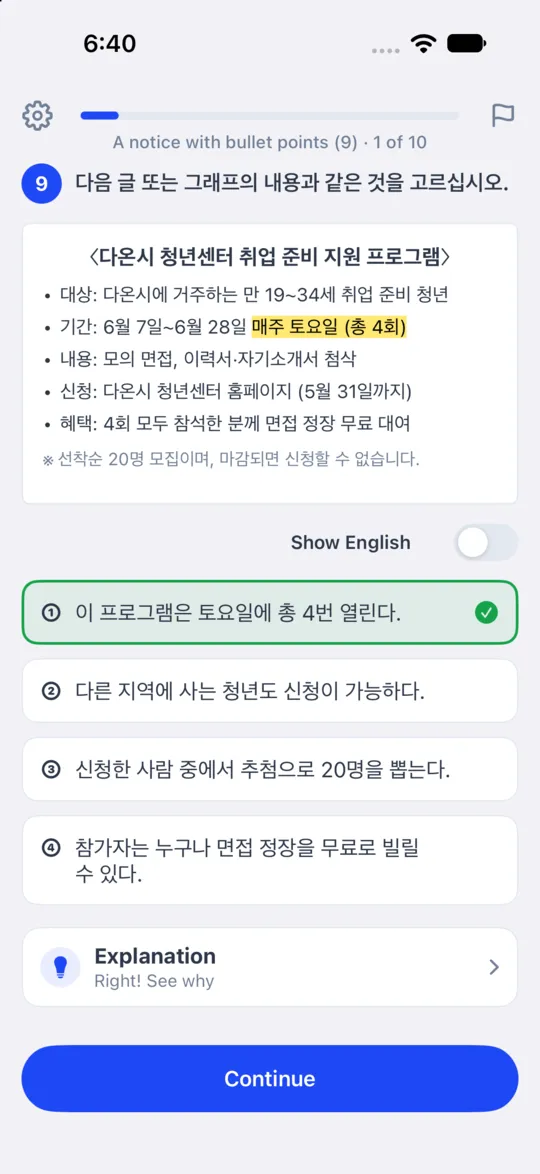
기간: 6월 7일~6월 28일 매주 토요일 (총 4회)
The program runs every Saturday for a total of 4 sessions, so it is held 4 times on Saturdays. Only young people living in Daon City can apply, and the 20 places are filled on a first-come, first-served basis, not by lottery.

Every part of TOPIK
Original questions written to the real exam's format, length and difficulty, one question type at a time.
Every question type, explained
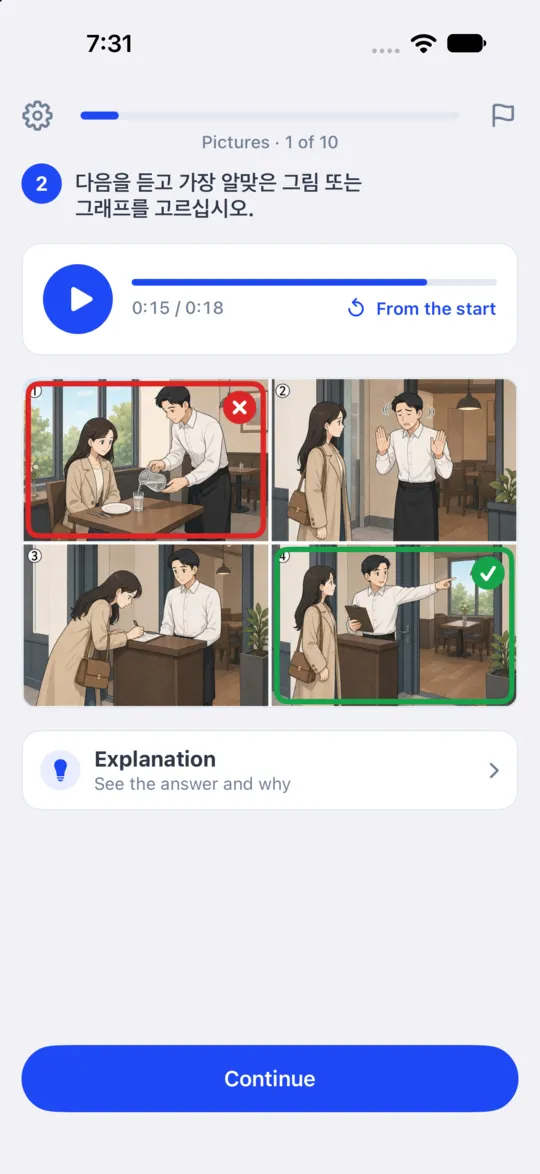
- All 12 reading question types
- Evidence highlighted after every answer
- A one-line trick for each type
- Every type tagged with its 급
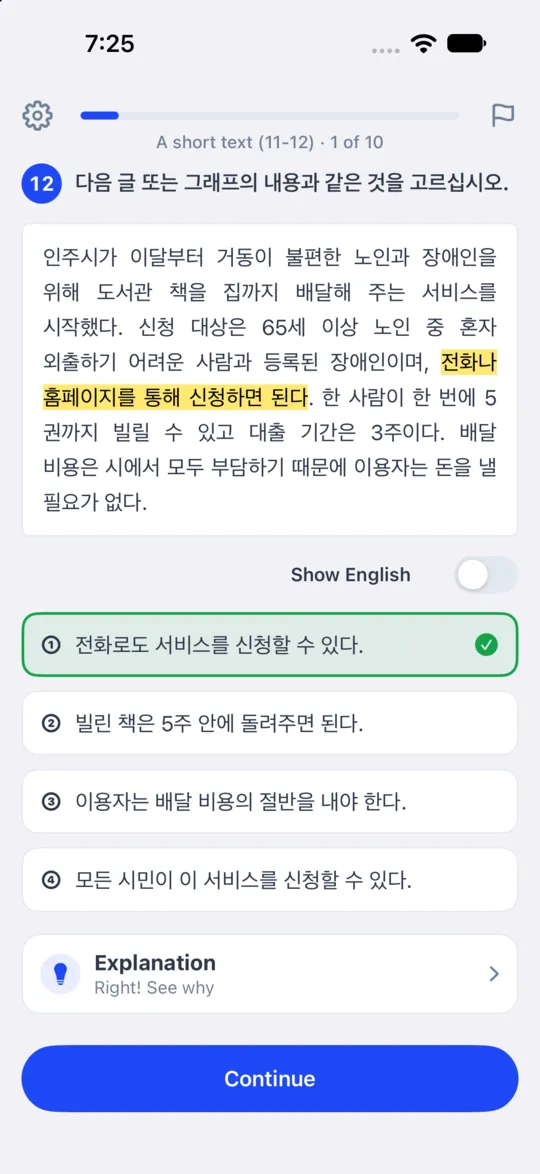
Hear it, then see why
- All 11 listening question types
- Picture and chart questions included
- Transcript and explanation after each answer
- A full 50-question test with chimes and pauses
Write on 원고지, get graded
- Questions 51, 52, 53 and 54
- 원고지 that follows the spacing rules
- AI grading with corrections
- A model answer for every question
원고지 rules
- 1One character per square
Every Hangul syllable takes one square. So do %, ~ and quotation marks.
학 생 들 이 - 2Leave the first square of a paragraph empty
Indent each new paragraph by one square: tap space once before its first word. Question 53 is usually one paragraph; question 54 has several.
□ 최 근 … - 3A space is one empty square
Write 띄어쓰기 exactly as in normal writing: one empty square between words.
조 사 하 였 다 □ 그 - 4Never start a row with a space
If a space would fall in the first square of a row, skip it and start the row with the next word.
- 5Period and comma: one square, nothing after
마침표 (.) and 쉼표 (,) take a square of their own, and the next word starts in the very next square, with no empty square after them.
다 . 그 결 과 - 6Question and exclamation marks: one square, then a space
물음표 (?) and 느낌표 (!) take a square, and the square after them stays empty.
까 ? □ 그 - 7Never start a row with a punctuation mark
When a period or comma falls at the start of a row, write it in the last square of the row above, together with the last character.
…였 다. (in one square) - 8Numbers and lowercase letters: two per square
Digits and lowercase English letters go two to a square. Capital letters take one square each.
20 23 년 · T O P I K - 9Write within the length
Question 53 asks for 200 to 300 characters, question 54 for 600 to 700. Spaces count: one square is one character. Below the minimum loses points.
The particle 으로는 fits the list-of-causes meaning better than 은.
Shorter and more formal; 것으로 is redundant after 때문인.
The full grade
A complete, accurate answer of 291 characters that covers the intro, both graphs, a linking sentence and the causes box, with every figure matching the chart. Structure and content are strong. Language is good but has some wordy phrasing and repetition, which keeps it at B.
Every block is present and every figure matches the chart: 120만 to 540만 (4.5배), 출퇴근 40만 to 320만 (8배), and 여가 80만 to 220만 (약 2.8배). The causes box gives both reasons from the chart.
The order is intro, graph 1, link, graph 2, then the box. Linking words (그 결과, 이를, 반면, 먼저, 다음으로) connect the ideas well, and each block is a clear paragraph.
The written -다 style is kept throughout. Grammar and vocabulary are mostly accurate and varied, with a few wordy or awkward phrases and some repetition of 증가.
The 한국교통연구원 survey and its subject are stated clearly.
Both values and the 4.5배 increase are correct.
이를 목적별 이용 건수로 살펴보면 links the two graphs.
Both lines are correct, and the contrast between 8배 and 약 2.8배 is clear.
Both causes from the chart (전용 도로 확충, 대여소 증가와 접근성) are given.
Who surveyed what is clear.
Trend and figures are in order.
Connects the two graphs smoothly.
Compares the two purposes with 반면.
Ordered with 먼저 and 다음으로.
The particle 으로는 fits the list-of-causes meaning better than 은.
Shorter and more formal; 것으로 is redundant after 때문인.
목적별로 is more natural than 목적별 이용 건수로 here.
The 에 after 데 is unnecessary and makes the sentence wordy.
Learn TOPIK vocabulary naturally

Learn the hanja behind TOPIK words
Most common questions
The PBT is the paper test: you answer on a mark sheet and write questions 51 to 54 by hand on 원고지 (squared manuscript paper). The IBT is the newer computer-based test, taken at a test center, where you type your writing answers and the writing section has three questions, with a shorter essay of 400 to 500 characters.
Sori covers both. Listening and reading practice is the same for either test, and in writing you can practice on 원고지 for the PBT or type for the IBT, with the essay set to the right length. The full mock test currently follows the PBT.
No. Every practice question is original, written by Sori to match the format, length and difficulty of the real TOPIK question by question. Sori is not affiliated with NIIED or the official TOPIK.
Answers to questions 53 and 54 are graded on the official TOPIK marking scheme: content and task, structure, and language use, each placed in a band and scored, with a note on what to improve. Answers that are empty, mostly copied from the question or not written in Korean are rejected before grading and do not use a correction. Questions 51 and 52 are checked instantly against every accepted answer.
Paid plans include 5 corrections a day, shared between questions 53 and 54, and the count resets every day at midnight UTC (9:00 in Korea).
Sori is not affiliated with NIIED or the official TOPIK.